
Money in Morocco: Currency, Exchange & Payment Tips for Travelers
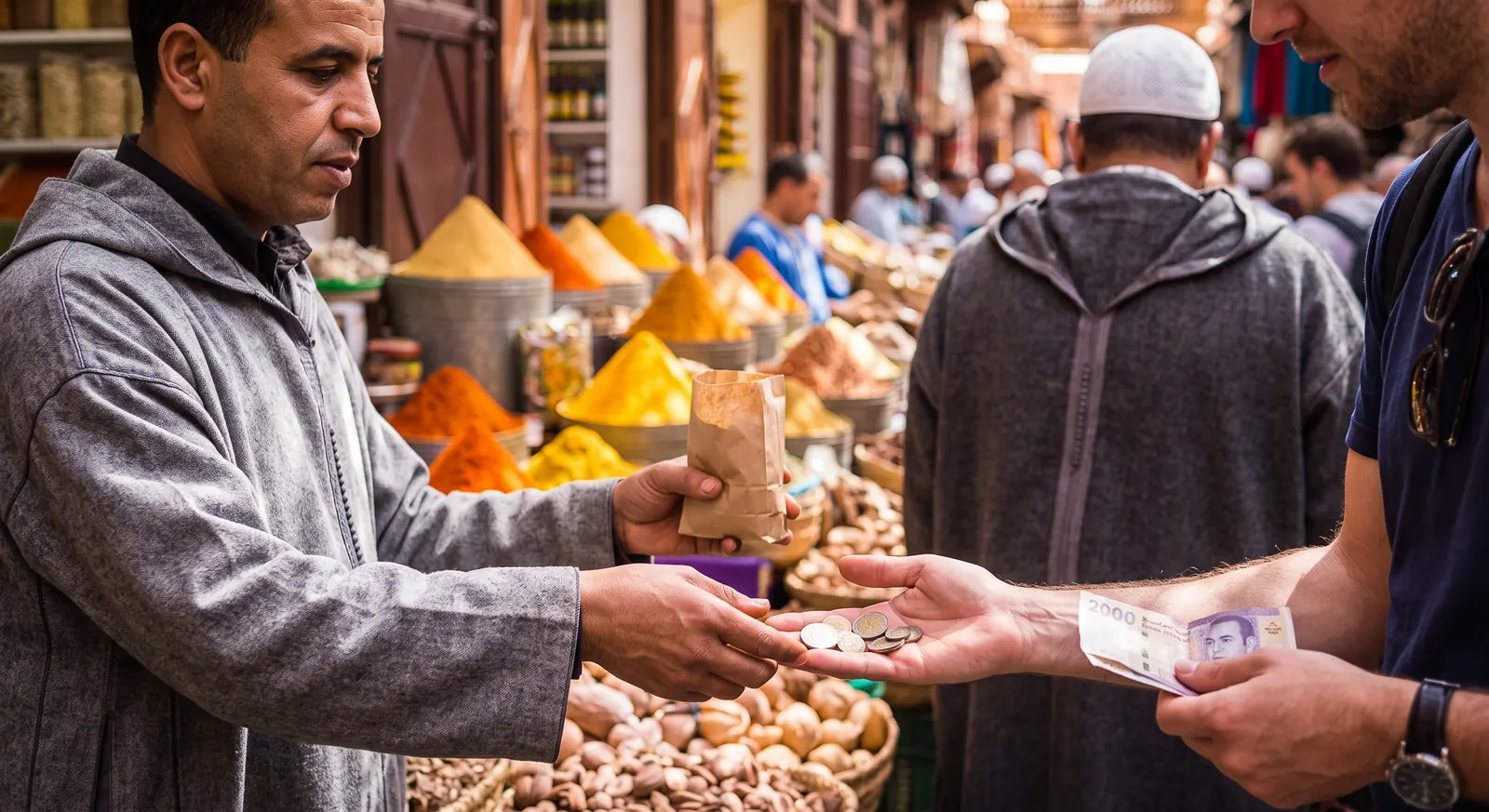
A practical guide to money in Morocco: Moroccan dirhams, ATMs, cash vs card, currency exchange, small notes and payment tips for Marrakech and beyond.
One of the first things you’ll need to figure out when arriving in Morocco is money.
What currency should you use? Where should you exchange your cash? Can you pay by card? How much cash should you carry?
Don’t worry. Once you understand a few simple things, using money in Morocco is quite easy.
The Moroccan Dirham
Morocco uses the Moroccan Dirham (MAD).
You’ll usually see prices written as DH, MAD, or simply “dirhams.”
At first, the notes and coins might be confusing, especially when you’re hearing prices quickly in the souks. But you’ll get used to them very quickly.
Banknotes
• 200 DH — roughly $14–15 • 100 DH — roughly $7–8 • 50 DH — roughly $3.50–4 • 20 DH — roughly $1.50
Coins
• 10 DH — roughly $0.75 • 5 DH — roughly $0.35–0.40 • 2 DH — roughly $0.15 • 1 DH — roughly $0.07 • 0.50 DH — roughly $0.04
These are only rough examples because exchange rates change.
And one thing worth remembering from the beginning:
20 DH does not mean $20.
You’ll hear prices in dirhams everywhere, so getting familiar with the currency will make your trip much easier.
Exchanging Your Money
You can exchange euros, US dollars and other major currencies at exchange offices throughout Morocco.
One thing travelers sometimes don’t realize is that the rate you see on Google may not be exactly the rate you receive at a local exchange office.
Google’s rate is useful as a reference, but exchange offices have their own rates and margins. So don’t be surprised if the rate you are offered is slightly different.
Our advice is to compare before exchanging a large amount.
Avoid exchanging large amounts at the airport
Airport exchange counters are convenient, especially when you have just arrived, but convenience doesn’t necessarily mean the best rate.
If you need some Moroccan money immediately for your transfer, food or first expenses, exchange a small amount.
Then, once you’re in the city, compare rates at reputable exchange offices before exchanging more.
And always count your money before leaving the exchange counter.
ATMs: A Convenient Backup
ATMs are widely available in Morocco, especially in cities and tourist areas.
You’ll find ATMs from banks such as Al Barid Bank, as well as many other Moroccan banks. Al Barid Bank has a large network across the country, and its official tariff information shows that ATM fees can depend on the type of withdrawal and card used. (Al Barid Bank)
So don’t assume that every ATM withdrawal is completely free.
There are potentially two different costs to consider:
• A fee charged by the Moroccan ATM or bank • A foreign transaction or withdrawal fee charged by your own bank
Always check the ATM screen before confirming the transaction.
One more ATM tip
Occasionally, an ATM can keep your card.
If that happens, getting your card back can take some time, especially if it happens outside banking hours or during a weekend.
For this reason, don’t make your bank card your only way of accessing money.
It’s smart to travel with:
• A backup card • Some emergency cash • Your bank’s contact information • Your card stored safely when you’re not using it
And never let a stranger “help” you with your card or PIN at an ATM.
Cash Is King
If there’s one rule we would give travelers, it’s this:
Cash is king.
Cards are becoming increasingly common in Morocco, particularly in larger cities, hotels, modern restaurants, supermarkets and established businesses.
Visa and Mastercard are generally useful cards to have.
American Express, however, is much more likely to be rejected, so don’t rely on it as your only payment method.
And even if you’re staying in a hotel where you can pay by card, you should still carry some Moroccan cash.
You’ll need it for things like:
• Souk shopping • Taxis • Small local restaurants • Street-food stalls • Local markets • Small independent shops • Tips • Small purchases
So the best approach is:
Card when available. Cash when necessary.
Always Check Before You Go
If you’re going somewhere specific, especially outside the major cities, it’s worth checking beforehand whether they accept cards.
A restaurant, activity, accommodation or shop may accept cards — or it may be cash only.
Don’t wait until you’ve finished your meal or activity to find out.
If you’re unsure, take enough cash with you.
At the same time, there’s no need to walk around with your entire travel budget in your pocket. Carry what you expect to need during the day and keep the rest somewhere secure.
Ask for the Price in Dirhams
When you’re shopping, especially in tourist areas, always ask for the price in Moroccan dirhams.
If someone tells you a price in euros or dollars, simply ask:
“How much in dirhams?”
This keeps things much clearer.
You don’t want a seller or service provider using their own exchange rate and then discovering later that the final price is higher than you expected.
If someone tells you something costs €50, for example, ask them to give you the price in DH and do the conversion yourself.
The local currency is always the clearest way to know what you’re actually paying.
Cash vs. Card Prices
In some places, you may notice that the price offered for a card payment is slightly different from the cash price.
There can be different reasons for this, including taxes, payment processing costs or how the business has structured its prices.
You may hear the term TVA, which is Morocco’s value-added tax.
Don’t automatically assume that every difference is a “card fee,” though. The important thing is to ask before paying:
“Is this the final price with TVA?”
and:
“Is the price the same if I pay by card?”
That way, you know exactly what you’re going to pay before the transaction is made.
Keep Small Notes and Coins
Small notes and coins are extremely useful when traveling around Morocco.
A 200 DH note isn’t always convenient when you’re paying for a small taxi ride, buying a snack or making a small purchase.
Try to keep some:
20 DH, 50 DH and 100 DH notes, along with a few coins.
If an ATM gives you mostly large notes, break them when you have the opportunity.
It will make everyday payments much easier.
Don’t Forget Your Change
When paying in busy places, especially markets and souks, take a moment to check your change before putting your wallet away.
This isn’t about assuming someone is going to cheat you. It’s simply good travel practice.
If you’re buying several things, make sure you know the total price before handing over your money.
And if you’ve negotiated a price, make sure both sides clearly agree on the final amount.
A Simple Money Strategy for Morocco
You don’t need to overthink money during your trip.
A good approach is:
Exchange a small amount when you arrive.
Compare exchange rates before exchanging more.
Use reputable ATMs when necessary.
Don’t rely on one card.
Carry some Moroccan cash every day.
Keep smaller notes and coins.
Ask for prices in dirhams.
Check whether card or cash is accepted before ordering.
Confirm the final price before paying.
And most importantly:
Cash is king, but a card is your backup.
Once you get used to Moroccan dirhams, you’ll quickly stop thinking about it and start enjoying the important part — exploring Morocco, eating good food, shopping in the souks and experiencing the country.
A little preparation with your money can save you a lot of unnecessary stress.
How Much Cash Should You Carry in Morocco?
There is no single amount that works for every traveler. Someone staying in an all-inclusive hotel and using private transfers may need very little daily cash, while a traveler shopping in souks, taking taxis and eating in small local restaurants will use cash much more often. A sensible approach is to carry enough Moroccan dirhams for the day while keeping the rest of your money and backup card securely stored.
When planning money in Morocco, think in categories: transport, food, small purchases, tips and activities. Keep a few smaller notes separate from larger bills so you do not need to open your full wallet every time you pay for a taxi, bottle of water or small souvenir.
Using ATMs in Marrakech, Fez and Other Moroccan Cities
ATMs in Morocco are easy to find in major cities and tourist centers. Whenever possible, use an ATM connected to a recognizable bank branch, especially if you are withdrawing a larger amount. Check the screen for any fee or currency-conversion option before confirming. Your home bank may also charge a foreign withdrawal fee even when the Moroccan ATM does not.
If a machine offers to convert the transaction into your home currency, read the rate carefully. Travelers often prefer to understand the cost before accepting any conversion offered at the ATM. The most important rule is to avoid rushing through screens you do not understand.
Paying by Card in Morocco
Card acceptance is improving, especially in hotels, higher-end restaurants, supermarkets and established shops. But “cards accepted” does not mean you can travel cash-free. Small businesses, local taxis, market stalls and rural stops may still operate mainly in cash. Visa and Mastercard are usually more practical than less commonly accepted networks.
Frequently Asked Questions About Money in Morocco
What currency is used in Morocco? Morocco uses the Moroccan dirham, usually shown as MAD or DH.
Should I bring cash to Morocco? Yes. Cards are useful, but cash remains important for taxis, souks, tips and many small local businesses.
Can I use US dollars or euros in Morocco? Some tourism businesses may quote foreign currencies, but the Moroccan dirham is the local currency and usually gives you the clearest basis for payment.
Are ATMs easy to find in Marrakech? Yes. Marrakech has many ATMs, particularly in central and tourist areas. Fees can depend on the ATM and your own bank.
Should I exchange money at Marrakech airport? Exchanging a small amount for immediate expenses can be convenient. For larger amounts, compare rates at reputable exchange offices in the city.
Is Morocco cashless? No. Card use is growing, but cash is still important throughout the country, especially outside major hotels and modern businesses.
*
Continue planning
Related Morocco travel advice
Time-sensitive information last checked: 26 August 2026.
Read next
More Morocco Travel Guides
View All Guides →
Marrakech Best Of: Our Local Picks
Our favorite rooftops, restaurants, cafés and riads in Marrakech — handpicked by Mouha Travel.
Bathrooms in Morocco: What Travelers Should Know Before Visiting Marrakech and Beyond
Wondering what bathrooms are like in Morocco? Learn about toilets in Marrakech, squat toilets, toilet paper, road-trip stops and Sahara desert camp bathrooms.
Things That Are Not Rude in Morocco — But Western Travelers Sometimes Think They Are
Learn Morocco etiquette before your trip: saying no, bargaining in souks, tipping, refusing food, personal questions and everyday Moroccan social customs.